Scuba Diving Vacation Together: Share the Underwater Adventure

Reading time: 10 minutes
Imagine gliding through crystal-clear water, colorful schools of fish drifting around you, and someone surfacing next to you who shares this exact magical moment with you. A scuba diving vacation together isn't just an adventure under water, it bonds you in a way few activities can. For many people who don't want to travel alone, diving offers a perfect mix of thrills, intimacy and shared experiences that go far beyond the classic beach vacation.
Finding the right travel companion for a diving vacation means more than just having someone to split the costs. It's about trust under water, a shared fascination with the underwater world and experiencing moments you'll look back on together for years to come. Whether you've dived before or are starting completely from scratch, with the right companion your first underwater adventure will be an unforgettable experience.
Why a scuba diving vacation together is more fun than going alone
By definition, diving is a buddy activity. For safety reasons, nobody should dive alone, and that's exactly what makes it the ideal shared activity. According to the Professional Association of Diving Instructors (PADI), the world's largest diving organization, the buddy rule is at the core of every dive training course. A trusted partner by your side not only increases safety, but also doubles the joy of the experience.
Being under water together creates a special bond. You communicate through hand signals, eye contact and a kind of nonverbal understanding that only develops when you spend time together. Anyone who has dived together knows: the silence under water, broken only by your own breathing, creates intimacy. You share moments of pure fascination with your companion when a sea turtle suddenly glides past or a school of barracuda crosses the scene.
For many in the sugar dating context, a scuba diving vacation together is also a way to take the relationship to a new level. While a classic beach vacation is relaxing, diving offers real adventure and challenges mastered. Especially when one partner is experienced and introduces the other, a dynamic of trust and care develops that has a positive effect on the whole travel companionship.
The best dive spots worldwide for beginners
Not every dive spot is suitable for beginners. Strong currents, poor visibility or great depths can overwhelm newcomers. That's why choosing the right destination is crucial for a successful scuba diving vacation together. Here are three proven destinations that are perfect for first dive experiences:
The Red Sea in Egypt: a classic with a guarantee
The Red Sea is considered one of the best dive regions for beginners in the world. Places like Sharm El Sheikh or Hurghada offer calm bays with gentle currents, warm water temperatures between 22 and 28 degrees Celsius (72 to 82°F) and visibility of often more than 30 meters (100 feet). According to the Association of German Sport Divers (VDST), more than 50,000 Germans do their first dives in Egypt every year. The house reefs of many hotels allow relaxed dives straight from the beach, without you needing to take a boat. Colorful coral reefs and a species-rich underwater world make every dive a visual experience.
The Maldives: luxury meets an underwater paradise
For those who want to combine diving with a touch of luxury, the Maldives are ideal. The atolls offer sheltered lagoons with shallow entry points and gentle currents. Many resorts have their own dive schools that offer courses in English. The average water temperature is a pleasant 27 to 30 degrees (81 to 86°F) year-round. A special highlight for beginners: the chance to see manta rays and reef sharks even on shallow dives. The combination of first-class infrastructure and breathtaking underwater scenery makes the Maldives a perfect destination for a scuba diving vacation together.
Thailand: affordable and beginner-friendly
The Thai islands of Koh Tao, Koh Phi Phi and Phuket are among the most popular destinations for beginner divers. Koh Tao is even considered the “diving capital of Southeast Asia,” with more than 40 dive schools on an island of just 21 square kilometers (about 8 square miles). An Open Water Diver course costs between $330 and $440 here, significantly cheaper than in many other destinations. The dive sites around Koh Tao offer depths between 5 and 25 meters (16 to 82 feet), perfect for first experiences. In addition, from March to September there's ideal diving weather with calm seas and good visibility.
Taking dive courses abroad together: how it works
Taking a dive course together not only strengthens your bond but also makes organizing easier. Most dive schools worldwide offer PADI or SSI certifications, which are internationally recognized. The entry-level course is called “Open Water Diver” and usually takes three to four days.
The process is standardized: first you complete theory lessons, either in a classroom or beforehand online via e-learning modules. Pool sessions follow, in which you practice basic skills like equalizing, buoyancy control and emergency procedures. Only then do you head into open water for four open-water dives, where you apply what you've learned.
Important when choosing a dive school: look for English-speaking instructors, especially if one of you is nervous. Communication has to work flawlessly, above all for safety instructions. Read reviews on platforms like TripAdvisor or Google and check whether the school is certified by PADI or SSI. You can also recognize a good dive school by small groups, ideally a maximum of four students per instructor.
Renting or buying dive gear: what's worth it?
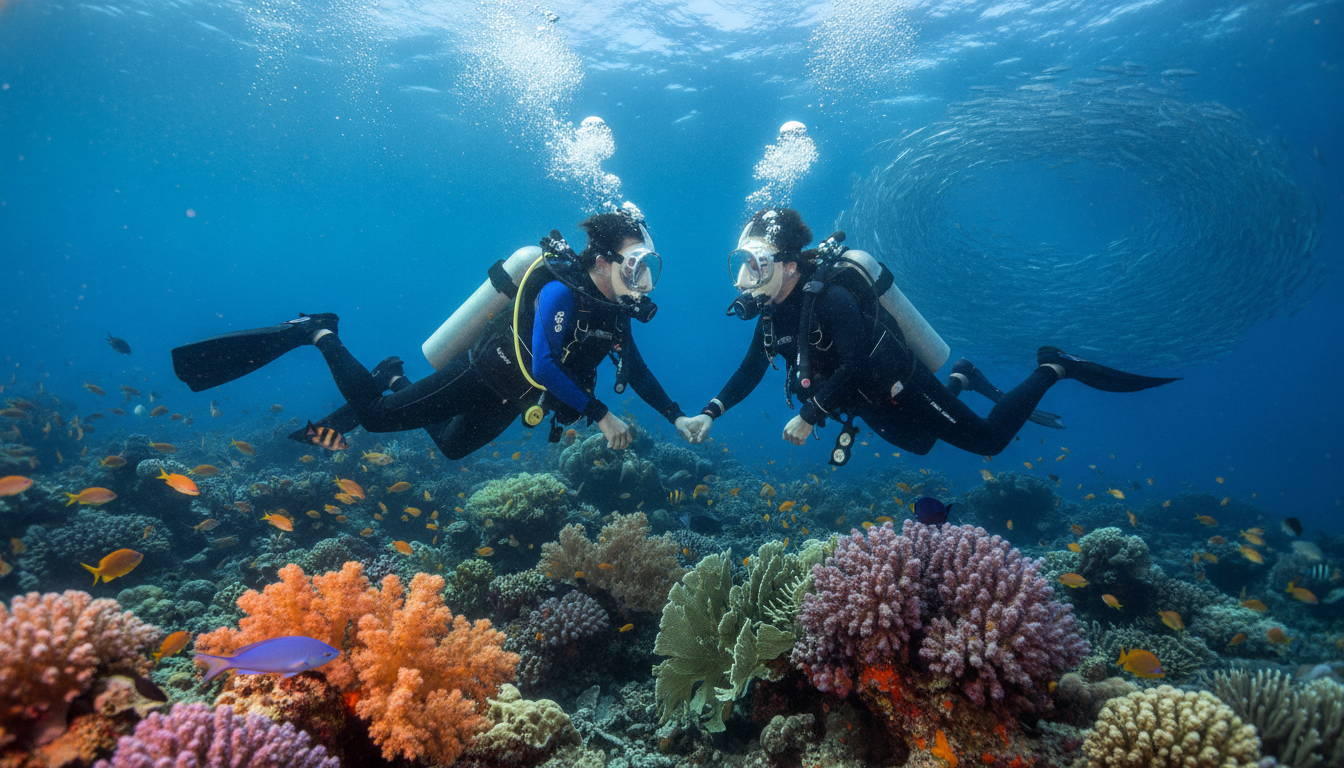
One of the most common questions on a first scuba diving vacation together: do we need our own gear, or is renting enough? The answer depends on your plans. For occasional divers who dive once or twice a year, renting is the more economical choice. A complete set of rental gear costs between $25 and $45 per day on site, depending on the destination and quality.
If you plan to dive regularly, though, investing in your own gear pays off. Buying is especially sensible for your mask, snorkel and fins, since these pieces are very personal. A well-fitting mask prevents water from getting in and lenses from fogging up. Cost: between $55 and $165 for a high-quality set.
Wetsuits, regulators and buoyancy vests are more expensive and less urgent. A good wetsuit costs between $220 and $550, and a complete regulator set can cost $650 to $1,650. This investment only makes sense once you plan at least 20 dives per year. Most dive centers offer modern, well-maintained rental gear. Important: always check the condition of the gear before the dive and report defects immediately.
- Mask and snorkel should fit perfectly, so buying them is worthwhile even on your first vacation
- Only buy a wetsuit if you dive in similar water temperatures: 3mm is enough in tropical waters, while in the Mediterranean you'll need 5-7mm
- Buy a regulator and buoyancy vest only after 30+ dives, once you know diving will become your passion
- Computer or console: renting is cheaper, but your own device makes it easier to keep a better logbook
Budgeting for a scuba diving vacation together
A realistic budget helps avoid nasty surprises. The cost of a scuba diving vacation together is made up of several factors. For a one-week dive vacation in Egypt, expect roughly $900 to $1,300 per person, including flight, accommodation, dive package and meals. In the Maldives or the Caribbean, the budget is more like $2,200 to $3,800 per person.
Dive packages are usually cheaper than single dives. A 10-dive package costs roughly $275 to $385 in Thailand and $220 to $330 in Egypt. Single dives come to $33 to $55. On top of that there may be costs for Nitrox tanks ($5 to $11 more per dive), which allow longer bottom times, or for boat trips to more distant spots.
Especially in the sugar dating context, splitting vacation costs is an important topic. Clarify beforehand who covers what. Often one partner takes care of the flights and accommodation while the other pays for the activities. Transparency builds trust and avoids misunderstandings. A clear agreement about who bears which costs makes sure you can concentrate on what matters: shared experiences under water.
Finding the right travel companion for a diving vacation
Not every travel companion is automatically suited to a diving vacation. What matters is that both partners at least have an interest in diving or are willing to try it. If one of you is already experienced, that can be an advantage, provided the experienced partner has patience and understanding for the other's learning curve.
When searching for a partner on travel companion platforms, you should communicate clearly about diving. A travel companion profile that shows your enthusiasm for diving or your openness to new experiences attracts like-minded people. Mention specifically whether you're a beginner or already have experience. That helps set realistic expectations.
Also make sure your travel companion is physically fit. Diving requires a certain baseline fitness, even though it isn't extremely strenuous. Anyone with health problems such as asthma, cardiovascular disease or ear problems should get medical advice beforehand. Most dive schools require a medical certificate before the course.
Safety first: important rules for beginner divers
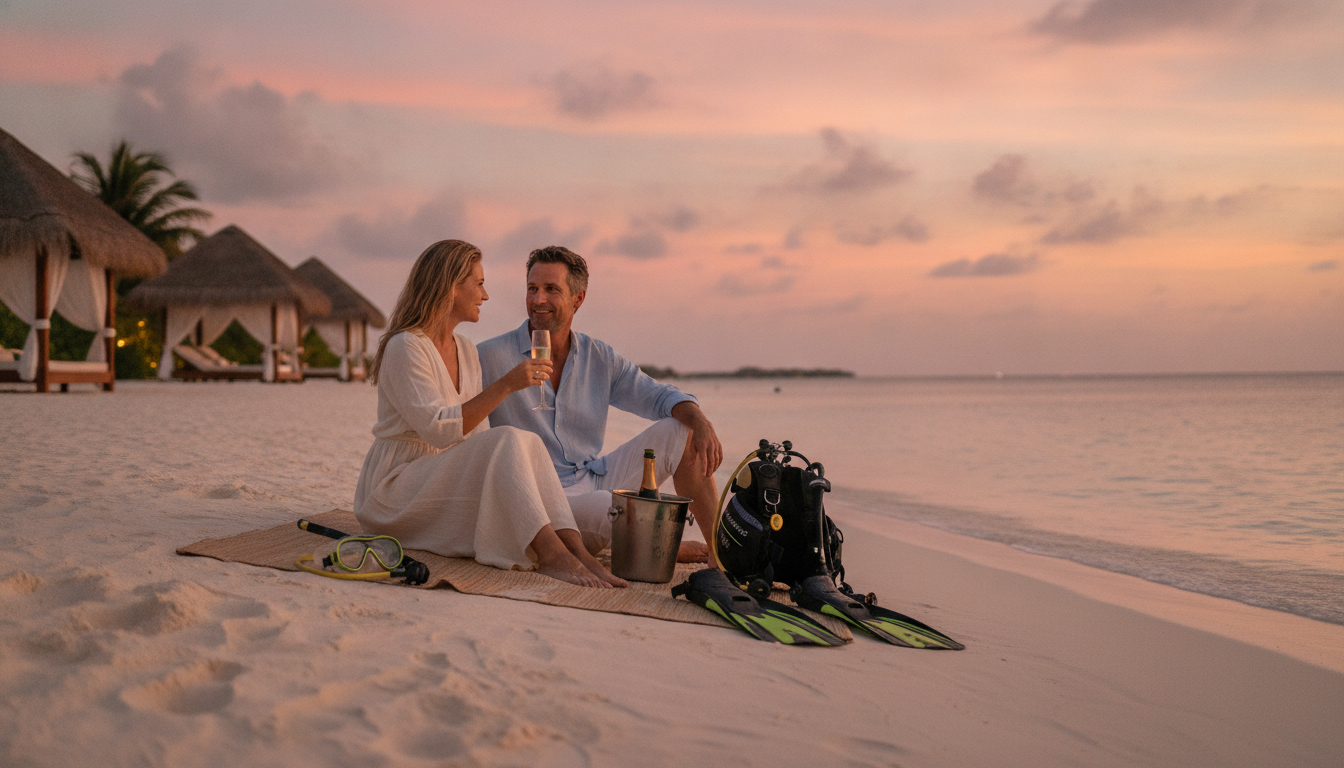
Diving is fundamentally safe if you follow the rules. The most important rule: never dive alone. The buddy rule is non-negotiable. Your partner is your lifeline under water. Always keep visual contact and stay within reach.
More essential safety rules: never dive deeper than 18 meters (60 feet) as an Open Water Diver. Ascend slowly, at a maximum of 9 meters (30 feet) per minute, to avoid decompression sickness. Make a safety stop at 5 meters (15 feet). Fly no earlier than 18 hours after your last dive, and preferably 24 hours. The pressure difference on a plane can otherwise lead to dangerous problems.
Listen to your body. If you feel uncomfortable, have a headache or something isn't right, abort the dive. No dive is worth risking your health. Good dive schools place great importance on safety and will never push you to do something you don't feel comfortable with.
Best travel times for different dive destinations
Timing can decide between success and disappointment. Every destination has its optimal diving season. For Egypt and the Red Sea, April to June and September to November are ideal. Water temperatures are pleasant, visibility is excellent and the tourist crowds stay manageable.
Thailand has two diving seasons, depending on the coast. The Andaman Sea (Phuket, Koh Lanta, Similan Islands) is perfect from November to April. The Gulf coast (Koh Tao, Koh Samui) offers the best conditions from March to October. The Maldives can be dived year-round, but the dry season from November to April brings the best visibility and calmest seas.
For long-haul trips that require a visa, plan ahead. A visa application for long-haul trips can take several weeks, especially for more exotic destinations like Indonesia or the Philippines. Take care of the formalities at least two months before departure.
Frequently asked questions about a scuba diving vacation together
Can I learn to dive even if I can't swim?
No, swimming is a basic prerequisite for dive training. Most diving organizations require proof that you can swim at least 200 meters (about 220 yards) or snorkel 300 meters (about 330 yards). You also have to be able to tread water for 10 minutes. If you're unsure, take a swimming course before your diving vacation.
How deep do beginners dive?
As an Open Water Diver, you may dive to a maximum depth of 18 meters (60 feet). That's completely enough to explore most reefs and underwater landscapes. The most beautiful corals and fish are found at depths between 5 and 15 meters (16 to 50 feet) anyway, where the light is still strong enough to show the colors.
Is diving dangerous?
Statistically, diving is safer than driving or skiing. According to the Divers Alert Network (DAN), the accident rate is around 3 to 5 incidents per 10,000 dives. Most of them are minor incidents. It only gets dangerous when rules are ignored or you go beyond your limits. With good training and attention to the safety rules, diving is a very safe activity.
Do I need dive insurance?
Yes, absolutely. Regular travel health insurance often doesn't cover diving accidents. DAN (Divers Alert Network) offers dedicated dive insurance starting at around $40 per year that is valid worldwide and also covers hyperbaric chamber treatment, which can cost several thousand dollars. Some dive schools require proof of dive insurance.
How long does a dive last?
A typical recreational dive lasts between 35 and 50 minutes, depending on depth, air consumption and diving conditions. In shallower waters you can stay longer, while at greater depths the time is shorter. After each dive comes a surface interval of at least one hour before you may dive again.
Conclusion: diving together bonds you for life
A scuba diving vacation together is far more than just another beach vacation. It's an experience that bonds, challenges and gives you moments you'll never forget. The right preparation, the right destination and above all the right travel companion make the difference between a nice vacation and an unforgettable adventure.
Whether you're both beginners or one of you introduces the other to the underwater world, experiencing this fascinating world together creates trust and closeness. Plan your first diving vacation carefully, choose a beginner-friendly destination and invest in good training. With every dive you'll become more confident, more relaxed and able to enjoy the beauty under water more.
Ready to discover the underwater world? Find the right travel companion who shares your enthusiasm, and set off together on your first underwater adventure. The oceans are waiting to be explored by you.