Visa Application for Long-Haul Trips: A Stress-Free Checklist
Reading time: 8 minutes
If you need a visa for your long-haul trip, you know that uneasy feeling: Are all the documents complete? Is there still enough time? Planning with a travel partner makes it even more complicated, because now two applications have to be coordinated. According to Germany's Federal Foreign Office, missing documents cause delays in more than 30 percent of visa applications. This article shows you how to tackle your long-haul travel visa application in a structured way and what to watch out for when you're not traveling alone.
Applying for a visa isn't rocket science, but it does take careful preparation. Especially on joint trips with a sugar daddy or a travel companion, you need to make sure both applications are submitted and approved at the same time. Otherwise one of you ends up holding a ticket without a valid visa.
Why You Should Start Your Long-Haul Travel Visa Application Early
Visa processing times vary considerably depending on the destination country. For a tourist visa to China, the Chinese embassy in Germany quotes an average of 4 to 10 business days, and for India the regular e-visa takes about 72 hours. But these timeframes only apply if all your documents are complete. If the authorities request additional paperwork, the process drags on for weeks.
A concrete example: in February 2024, a couple from Chicago planning a trip to Thailand didn't need a visa at first, since U.S. citizens could enter visa-free for stays of up to 30 days. But they planned a 45-day stay and therefore had to apply for a tourist visa. Processing at the Royal Thai Consulate-General in Los Angeles took 3 business days, but the first appointment to submit the documents wasn't available until 6 weeks after they applied. If you underestimate lead times like these, you risk the entire trip.
When planning with a travel partner, you should start your visa research at least 8 to 12 weeks before departure. That leaves enough buffer for follow-up questions, additional documents or unexpected consulate closures.
Which Documents You Need for Your Long-Haul Travel Visa Application
Almost every visa application for long-haul trips requires a passport that is valid for at least six months beyond your return date. Many people overlook this detail: if your passport expires in October 2025 and you want to travel in April 2025, it's already invalid for many countries.
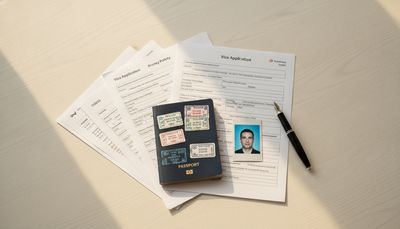
The following documents belong on the standard checklist:
- Passport with sufficient validity (at least 6 months)
- Fully completed application form (often online via consulate websites)
- Biometric passport photos (size and format vary by country)
- Proof of accommodation (hotel bookings or an invitation letter)
- Flight booking or itinerary (a reservation without payment is often enough)
- Proof of funds, such as bank statements from the last three months
- Travel health insurance with a minimum coverage amount (e.g., 30,000 euros for Schengen visas)
For Russia, for example, the consulate requires an official invitation in addition, which has to be issued either by a hotel or by a registered individual. This invitation costs between 20 and 50 euros (roughly $25 to $55) and takes 5 to 7 business days. You'll find country-specific requirements like these on the official website of the relevant consulate.
Preparing Your Proof of Funds Correctly
Proof of funds is often a stumbling block. The Australian embassy, for example, requires demonstrably available funds of about 5,000 AUD (roughly $3,300) per person for a Visitor Visa. When traveling with a travel companion, it's important to clarify who covers the costs. If a sugar daddy is financing the trip, this should be documented through joint bookings or an invitation letter.
Bank statements must be current, usually no older than 30 days. They shouldn't show any conspicuous deposits shortly before you apply, as this can raise doubts about your financial stability.
Applying for a Visa: Online or in Person at the Consulate?
More and more countries offer electronic visas, known as e-visas. India introduced its e-Tourist Visa in 2014; you apply online and receive it by email within 72 hours. You print it out and show it on arrival. According to the Indian Bureau of Immigration, the fee is currently 25 US dollars.
Other countries such as Kenya, Sri Lanka or Turkey have similar systems. The advantage: no appointment to book, no trip to the consulate, faster processing. The downside: if you run into technical problems or unclear cases, there is no direct contact person.
For more complex visas such as the Chinese or Russian tourist visa, going to the consulate or using a visa service is often unavoidable. In cities like New York, Washington D.C., Chicago, San Francisco and Los Angeles, there are specialized visa agencies such as CIBT or Travisa that handle the application for a fee. The cost is $75 to $200 on top of the consular fees, but it saves time and nerves.
Coordinating Two Applications
If you're traveling with a travel companion, both applications should ideally be submitted at the same time. Some consulates, such as the Chinese ones, allow joint appointments for couples or travel groups. Find out in advance whether this is possible, and book appointments for the same day.
With e-visas, coordination is easier: you both fill out your applications in parallel and submit them on the same day. That way you avoid one person already having the visa while the other is still waiting. It also makes further planning easier, such as hotel bookings or splitting vacation costs.
Avoiding Common Mistakes in Your Long-Haul Travel Visa Application
A common mistake is submitting old or incorrect passport photos. Many countries require biometric photos to a strict standard: often 35 x 45 mm (or 2 x 2 inches), white background, neutral expression, no glasses. The U.S. has even stricter requirements. Photos that are older than six months or don't meet the specifications lead to your application being rejected.
Another problem: incomplete forms. For the Chinese visa application, for example, you have to list all the countries you've visited in the past twelve months, including exact dates. Gaps or inaccuracies are viewed critically and can lead to follow-up questions.
Travel health insurance is also often underestimated. For Schengen visas, insurance with at least 30,000 euros of coverage is mandatory. The insurance must cover the entire Schengen area and be valid for the whole length of your stay. A simple screenshot of an online booking often isn't enough; you need to present an official confirmation of insurance.
Budgeting Realistically for Costs and Fees
Visa fees vary widely. A tourist visa for Kenya costs 51 US dollars as an e-visa, and for Australia you pay 190 AUD (about $125) for an Electronic Travel Authority (ETA). The Chinese tourist visa comes to 125.45 euros (as of January 2025, according to the Chinese embassy in Berlin).
Service fees often come on top: if you use a visa service, add $75 to $200. If you have to appear in person at the consulate, travel costs may apply. For two people, these expenses quickly add up to $450 to $650, which you should factor into your travel budget.
If you're traveling with a sugar daddy or a wealthy travel partner, you should clarify in advance who will cover the visa costs. Transparent agreements prevent misunderstandings. On platforms for traveling together and travel companionship, this question is part of coordinating when you find the perfect travel partner.
Checking Entry Requirements: Use Official Sources
Visa regulations are constantly changing. What applied six months ago may be outdated today. The most reliable source is the U.S. Department of State at travel.state.gov, with detailed travel and safety advisories for every country. There you'll find current information on visa requirements, entry conditions and the security situation.
It's also worth checking the website of the destination country's embassy or consulate in the United States. The information there is usually more precise than on general travel portals. For China, for example, the Chinese embassy in Washington, D.C. offers detailed instructions for visa applications.
Beware of third-party providers: many commercial visa services advertise "official" applications but charge significantly higher fees than the consulate itself. Always check whether you can apply for the visa directly.
Practical Tips for a Stress-Free Visa Application as a Pair

Create a shared checklist with your travel partner. Use tools like Google Docs or Trello to track your progress. Mark completed steps and set reminders for important deadlines.
Scan all important documents and store digital copies in the cloud. That way you'll have access to your passport, visa, insurance policy and flight tickets on the road in case the originals get lost.
Plan a joint day for submitting your applications if you both need to go to the consulate in person. That saves travel time, and you can support each other if questions come up.
Also find out about transit visas. If you're changing planes in Singapore or Dubai on the way to Australia, you sometimes need a transit visa even if you don't leave the airport. The rules differ depending on the length of your layover.
Frequently Asked Questions About the Long-Haul Travel Visa Application
How long before my trip should I apply for the visa?
Ideally 8 to 12 weeks before departure, to leave enough buffer for processing times and possible requests for additional documents. Some countries, such as India, offer expedited visas, which cost more but are issued within 24 hours.
Can I apply for a visa with an expired passport?
No, your passport must be valid when you apply and usually for at least six more months beyond your return date. Renew your passport in good time, as the application can take up to 10 weeks.
What happens if my visa application is rejected?
You'll receive a rejection notice with an explanation. In many cases you can appeal or submit a new application with corrected documents. However, the fees you've already paid are not refunded.
Do both travel partners need the same visa documents?
Yes, in principle every person has to submit all required documents individually. You can both use joint hotel bookings and flight tickets, but bank statements and insurance must be personalized.
Can a visa service guarantee faster processing?
No, visa services are also subject to the consulates' processing times. They can simplify the process and help you avoid mistakes, but they can't work miracles. With e-visas, applying yourself is usually just as fast.
Conclusion: With Careful Planning, the Long-Haul Travel Visa Application Becomes a Breeze
The visa application for a long-haul trip doesn't have to be a source of stress if you start early and work systematically. Check entry requirements on official websites, put together all your documents completely, and coordinate closely with your travel partner. Especially on joint trips with a sugar dating background or through platforms for travel companionship, a clear division of tasks pays off.
With this checklist and these concrete tips, you're well prepared. Don't forget to keep copies of all important documents within reach during your trip as well. That way nothing stands in the way of your shared adventure. Find out about the visa requirements for your destination now and start your next long-haul trip relaxed!